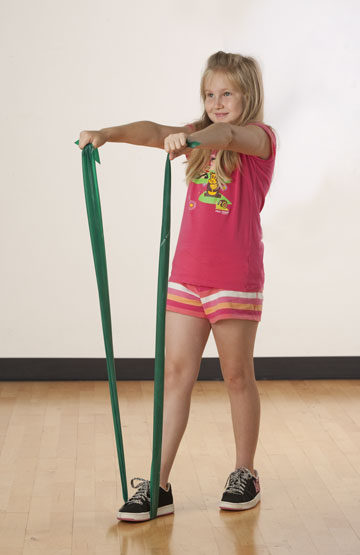
From my previous blogs I've talked about the benefits of strength and resistance training from an adult standpoint, yet I haven't got into how it effects the youth. Well, despite the previous belief that strength training was bad for children that it "stunted growth" or "inhibited them" was a hoax, or in other words complete and utter nonsense. Just like adults, strength training has valuable positive benefits for children. According to John A. Bergfeld, head team physician of the Clevland Brown's, he defines strength training related to children as a method of "conditioning designed to increase an individual's ability to exert or resist force. The goal is not to see which child is the strongest, but to improve the musculoskeletal strength. Strength training can mean using weights, or it can mean doing sit ups, push ups and leg curls without weights. "
When you look at it in this perspective, I'm not talking about putting a child on a 7 day a week, 2 hour a day hypertrophy weight training session, I'm talking about regular fitness to improve the child's quality of life. According to recent studies from the American College of Sports Medicine (ACSM) and the National Strength and Conditioning Association (NSCA), they now "support children's participation in appropriately designed and competently supervised strength training programs." These experts have found that strength training can be safe and an effective means to improve a child's qualtiy of life. In addition, it may also help prevent certain sports-related injuries among young athletes. Recent findings suggest that strength training during childhood and adolescence may make bones stronger, a benefit which can last a lifetime.
The same methods for adults usually apply to children in terms of showing them proper form and technique. Children also learn best by doing not by watching so supervision is key to make sure they perform the exercises the right way. In addition, proper diet is also important, such as appropriate amounts of carbs, fats and proteins to keep them energized and allow them to build muscle.
The best time to start a child on a strength training program is if the child is involved in athletics or some type of physical activity where strength training can benefit them. So if the child is starting athletics around the age of 7 or 8, implementing a strengthening program would be a good idea.
Warming up and stretching should be performed before every session. Since children are more prone to heat illness than adults, they should be encouraged to drink plenty of water throughout the workout. For a beginning program, start with one set of 10-15 repetitions of 6-8 exercises that focus on the major muscle groups of the upper and lower body. Start with light weight and high reps and increase the load and decrease the reps as strength improves (ACSM).
What's important to understand from this is advocating exercise, physical activity, strength training and proper diet at an early age will only have positive effects on the child's lifestyle choices as they grow into their adult years.
Thursday, October 29, 2009
Sunday, October 25, 2009
Best Cardiovascular Workout Routine
Running, biking, swimming, walking, eliptical training: lets be honest they're boring to do. I mean, yes it feels good after a nice long run or biking trails can be fun but a stationary bike or treadmill running is just boring and quite frankly a waste of time. You need cardiovascular training for fitness, health and possibly fat loss but those traditional methods that we all know so well but hate to do isn't the most effective option. On top of that, the high impact that running puts on your joints over time can be stressful. The method:
Circuit Training: A circuit training routine that builds muscle and endurance in one work out is by far the best method. The energy system which is predominately used in circuit training, as i've talked about in one of my previous blogs is the Glycolytic zone. This zone is optimal for fat loss.
What is Circuit Training?
- Well, Circuit Training incorporates high intensity aerobics along with resistance training. Each circuit incorporates roughly 3-5 exercises with no rest. Following the circuit (doing a set for each exercise in the circuit) you can rest for a minute. For optimal results, a training session that incorporates multiple circuit routines within a workout is best for caloric expenditure and fat loss.
Why Circuit Training?
- As stated, this exercise method is the best for fat loss, so if that is your desired goal then this is the best training method. Circuit training incorporates resistance training which deals with EPOC or Excess Post- exercise Oxygen Consumption. So, after a workout your body needs to bring itself back to it's original homeostatic state. This is done by consuming oxygen at an elevated rate. Weight training or resistance training is thought to have a greater rate of EPOC compared to regular aerobic exercise (running, biking etc).
A circuit training routine is time relative, which means you do each set of each exercise as many times as you can within a desired time limit (roughly a minute usually).
An example of a typical circuit routine would be a minute of each exercise, followed by a minute of rest after the circuit is completed. Heres an example of an intermediate circuit routine:
1.) Squats
2.) Pushups
3.) Lunges
4.) Inverted rows
5.) Burpee's (Start standing up and then bend and put your hands of the ground and kick your legs back so that you end in a push up position, then thrust your legs forward between your arms and jump into the air.)
- This incorporates both upper and lower body high intensity work, resulting in large caloric expenditure, good cardiovascular and muscular endurance training. So get out there and try this form of training, trust me you'll feel it and it definitely works!
Circuit Training: A circuit training routine that builds muscle and endurance in one work out is by far the best method. The energy system which is predominately used in circuit training, as i've talked about in one of my previous blogs is the Glycolytic zone. This zone is optimal for fat loss.
What is Circuit Training?
- Well, Circuit Training incorporates high intensity aerobics along with resistance training. Each circuit incorporates roughly 3-5 exercises with no rest. Following the circuit (doing a set for each exercise in the circuit) you can rest for a minute. For optimal results, a training session that incorporates multiple circuit routines within a workout is best for caloric expenditure and fat loss.
Why Circuit Training?
- As stated, this exercise method is the best for fat loss, so if that is your desired goal then this is the best training method. Circuit training incorporates resistance training which deals with EPOC or Excess Post- exercise Oxygen Consumption. So, after a workout your body needs to bring itself back to it's original homeostatic state. This is done by consuming oxygen at an elevated rate. Weight training or resistance training is thought to have a greater rate of EPOC compared to regular aerobic exercise (running, biking etc).
A circuit training routine is time relative, which means you do each set of each exercise as many times as you can within a desired time limit (roughly a minute usually).
An example of a typical circuit routine would be a minute of each exercise, followed by a minute of rest after the circuit is completed. Heres an example of an intermediate circuit routine:
1.) Squats
2.) Pushups
3.) Lunges
4.) Inverted rows
5.) Burpee's (Start standing up and then bend and put your hands of the ground and kick your legs back so that you end in a push up position, then thrust your legs forward between your arms and jump into the air.)
- This incorporates both upper and lower body high intensity work, resulting in large caloric expenditure, good cardiovascular and muscular endurance training. So get out there and try this form of training, trust me you'll feel it and it definitely works!
Friday, October 16, 2009
Why Kettlebells Represent FUNCTIONAL TRAINING in it's Purest Sense
The History: Since the 1800's, Kettlebells have slowly but surely made their way into the mainstream spotlight as one of the top, new ways to improve physical fitness. Developed in Russia as a counterweight for market produce sales, the kettlebell was born. First being used by the farmers as a juggling instrument which turned into exercise brought upon "Girevoy Sport", which in Russian means Kettlebell sport. In 1948 Russians commenced kettlebell sport (Girevoy sport) which pitched a man and a time clock against the maximal repetitions obtained in 3 types of lifts , the snatch (weight swung with one arm straight above head ) , the clean & jerk ( 2 bells swung to chest once , and then put overhead as many times as possible) and the one armed push press. This sport inevitably made it's way to America and the Kettlebell is now one of the best overall functional exercise tools of our time.
Now that the history is out of the way, lets talk about the importance and overall greatness of kettlebells.
When an individual typically weight trains, as I've talked about in my previous blogs, they train in one plane of motion. Kettlebell training uses momentum rather than stationary strength to produce movements. Training in multiple planes while using momentum, kettlebell training improves the body's cardiovascular level, postural control, total body muscular strength, endurance and power.
The Science: You see, when a regular free weight is situated in your hand, the center of the mass, being the weight, is in the palm of your hand. Thus when performing any exercise with a free weight the center of the mass remains constant and the lever stays the same. A kettlebell has a U-shaped handle so the center of the mass of the kettlebell lays outside of ones hand. As the kettlebell rotates around the person's hand while performing an exercise, the kettlebell rotates therefore creating a fluctuating resistance arm and a variable lever length throughout each exercise that is performed. In addition, while performing rotational exercises, such as a single arm swing, centrifugal force is involved creating a greater inertia.
The functionality: Ask yourself this next time you go into a gym and look at the people lifting weights, "what are they doing?" More than likely someone's either standing up, laying down in the supine position or sitting up moving a single joint in a stationary position. Ask yourself another question, "Is that how we move?", do people actually move in one plane of motion. When are you actually every going to press something over your head while you sit in a chair, probably never!!! That is why kettlebells are a great way to incorporate the various muscle groups into a single motion while still getting the great strength training effects of free weights.
Being both durable and economic, kettlebells can train people in all walks of life whether being young fit and athletic of elderly. So next time you get into the gym, see if they have some kettlebells and try it out for yourself. As always I stress proper form and technique, so if you are going to begin a kettlebell routine, you should educate yourself on the proper movements and safety behind using these great tools.
Wednesday, October 7, 2009
Know Your Muscles for Optimal Training!!!!
(http://www.brianmac.co.uk/energy.htm)
What many people don't know about the human body in terms of the muscular system is that their is more than one type of muscle fiber. Actually, the muscle fibers can be classified as Type I which is slow twitch and Type I which is fast twitch. From there you can further categorize Type II fibers into Type II-A and Type II-B.
Type I muscle fibers have the slowest-contractile speed, the smallest cross-sectional area, the highest oxidative (aerobic) capacity, and the lowest glycolytic (anaerobic) capacity. They contract slowly and are able to hold a steady paced twitch for long durations without fatigue. Type I muscle fibers are predominately used in endurance activities. Long distance runners, swimmers, and cyclists mostly use Type I fibers.
Type II-B muscle fibers have the fastest-contractile speed, the largest cross-sectional area, the lowest oxidative capacity, and the highest glycolytic capacity. They are ideally suited for short fast bursts of power. These muscle fibers are used in such activities as sprinting, power lifting, and bodybuilding. Type II-A muscle fibers are intermediate and their properties lay between types I and type II-B.
Now that we've gone over the fiber types, we need to look at the energy that your body uses to fuel your muscles. Nutrition is very important in muscle function because your body converts the food it takes in and converts it into usable energy to fuel the muscle, this is called ATP or Adenosine Triphosphate. ATP is the immediate source of energy for muscle contraction. The human body makes ATP readily available through the three energy systems: Creatine-phosphate system or ATP-PC system, glycolytic system and the oxidative system.
1.) ATP-PC system produces ATP the fastest amongest the other energy systems but only gives us 5-8 seconds of ATP
2.) The Glycolytic system or the Lactic Acid system due to the production of lactic acid as a by product. This system usually lasts less than two minutes and is used in moderately intense exercise. This system uses glycogen to produce ATP in addition this system doesn't utilize oxygen thus being called anaerobic (w/o O2).
3.) The Oxidative System comes into play for activities lasting longer than two minutes. It produces the greatest amount of ATP but takes the longest to produce it. This system uses the three macronutrients (proteins, fats and carbohydrates) to produce ATP. Oxygen is needed for this system to produce ATP.
Since we know the muscle fiber types and how the energy systems work, here is how reps effect strength and the muscle fibers:
| Overview | Growth In Muscle Fibers Below | |||
| Repetition Range | Type I | Type IIA | Type IIB | Strength Gains |
| 1-2 repetitions | Very Low | Low | Low | Excellent |
| 3-5 repetitions | Very Low | Low | Decent to Good | Excellent |
| 6-8 repetitions | Very Low | Good | Excellent | Good |
| 9-12 repetitions | Low | Excellent | Very Good | Good Within Rep R. |
| 13-15 repetitions | Decent | Very Good | Decent to Good | Endurance |
| 16-25 repetitions | Very Good | Diminishing | Low | Endurance |
| 25-50 repetitions | Excellent | Low | Very Low | Endurance |
(http://www.criticalbench.com/muscle-fiber-type.htm)
So as you can see, the best range for strength and definition is 1-8, while muscular endurance is 12-50 reps.
Subscribe to:
Posts (Atom)


